Shops leave thousands per repair uncollected — not because the damage isn't real, but because writing and defending a supplement takes an hour nobody in the shop has. Teardown documents the work you actually performed, prices it, and writes the argument that gets it approved.
Pre-pilot · Bay, Desk and Ledger · $500–1,000/mo per shop
The problem
Nothing here is exotic. Every shop owner recognises all four of these, and most have accepted them as the cost of doing business.
Hidden damage shows up the second the panel comes off. The technician is paid to fix cars, not to photograph and annotate them, so the find stays in his head until it is out of his head. By the time the estimator asks, the car is reassembled.
A supplement typed between two phone calls carries no labelled photo, no OEM procedure citation and no wording that carrier is known to accept. The adjuster denies it in thirty seconds — not because it's wrong, but because there is nothing in front of them to approve.
Every shop has one estimator who knows which carrier pays for feather, prime and block if you call it the right thing and attach the right document. That knowledge is unwritten, unbacked up, and walks out with him.
Contesting one denied line takes an hour of phone calls and paperwork. On a $180 item most shops write it off. The carrier learns, correctly, that denial is close to free.
How it works
The technician's part takes under thirty seconds. Everything after that is the estimator reviewing work that has already been drafted for them.
What it is
Nobody is asked to change how they work. The technician keeps fixing cars, the estimator keeps estimating, the owner finally gets a number.
Bay · phone · technician
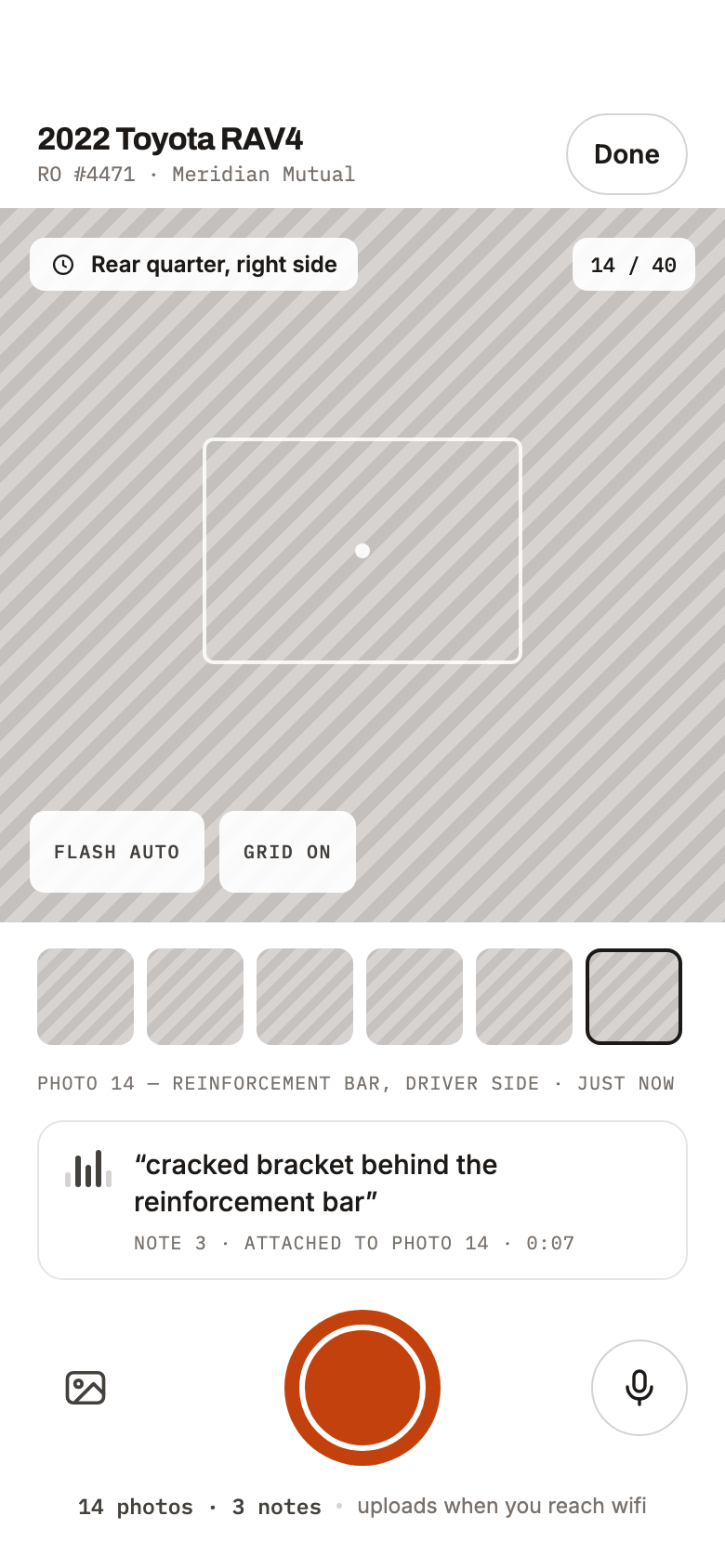
Under thirty seconds per car. Point, shoot, say what you found. It works with gloves on and no signal in the back of the shop.
Desk · browser · estimator
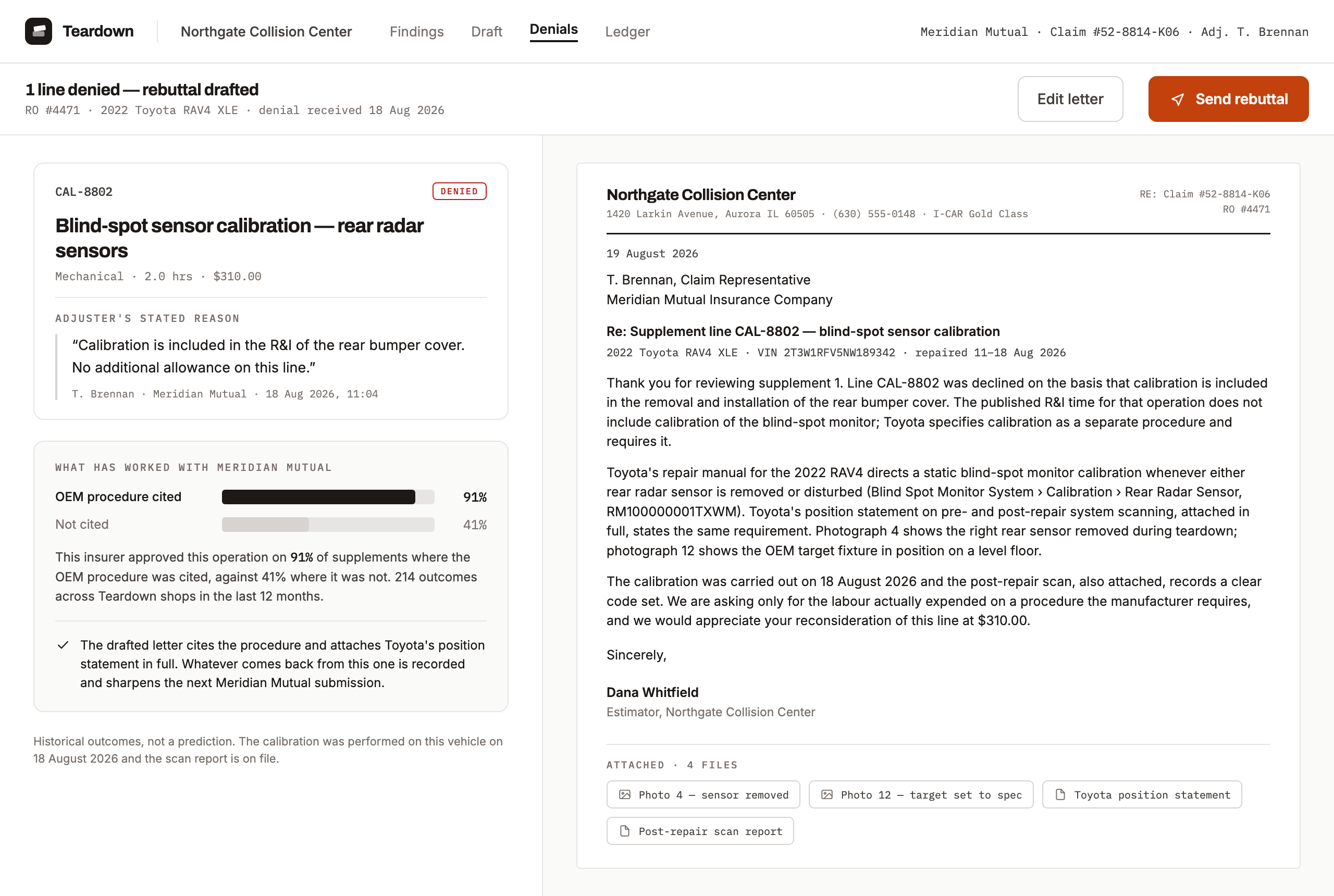
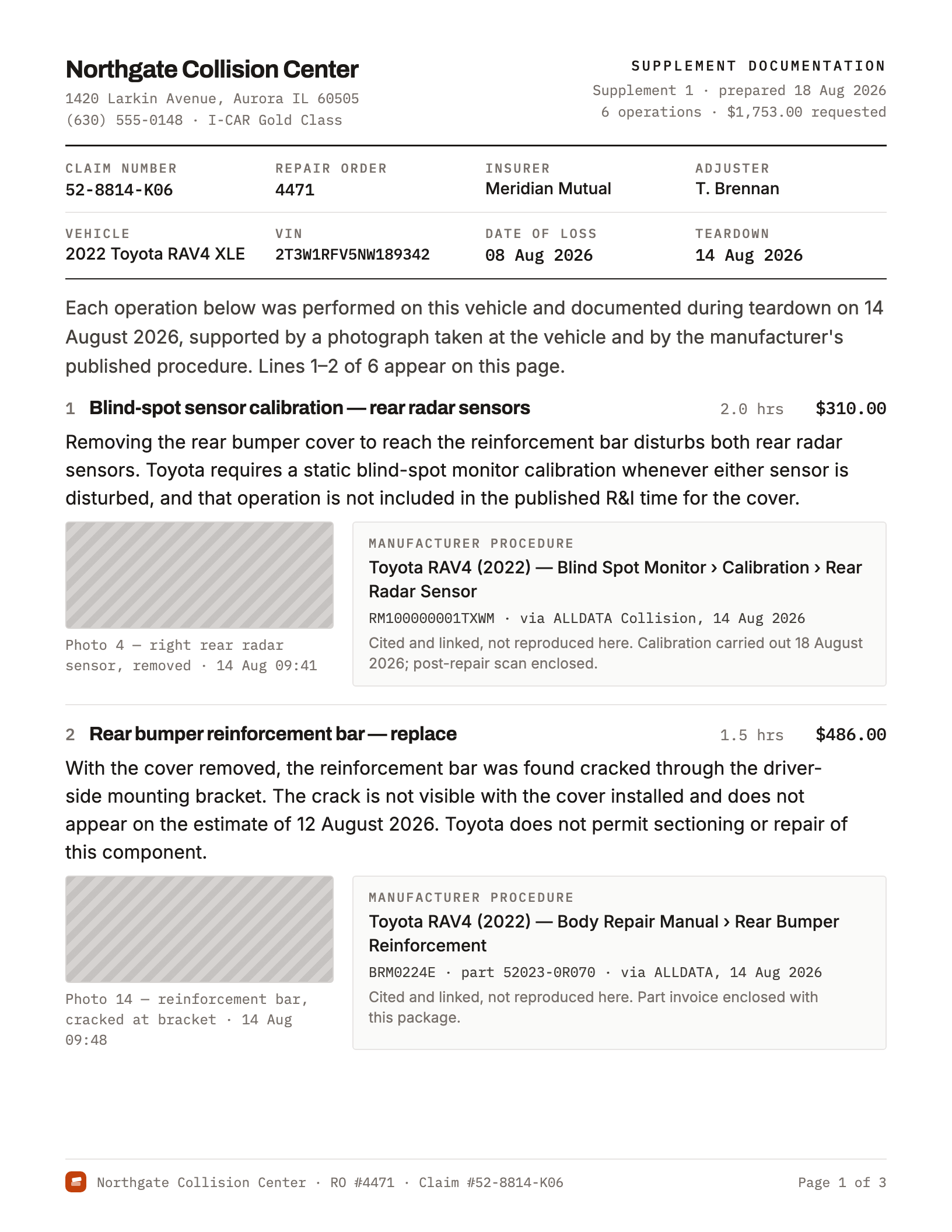
Findings with citations attached, a documentation package the adjuster can act on, and a drafted rebuttal waiting the moment something is denied.
Ledger · browser · owner
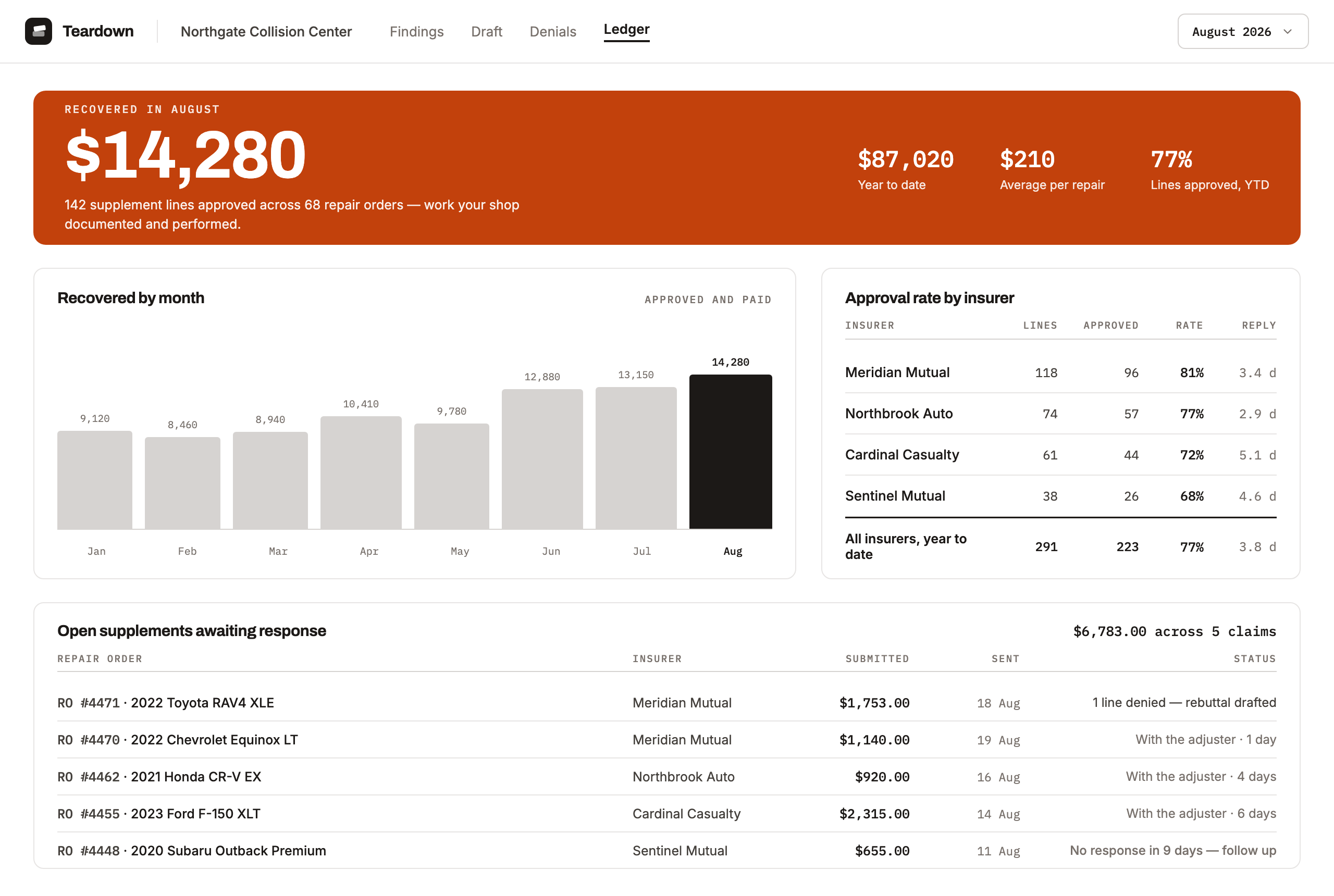
What came back approved, what was denied and by whom, what is still outstanding. The number the shop can check against its own bank account.
Which operations each insurer approves, what evidence they require, what wording works — held as structured rows, not vague similarity. Seeded from the public Who Pays for What? surveys, the Database Enhancement Gateway, and paid interviews with veteran estimators, then grown by outcomes. Retrieval is an exact filter and every answer is auditable, because money is involved.
OEM repair procedures are copyrighted, so Teardown cites and links into the shop's existing ALLDATA or RepairLogic subscription rather than republishing them. OEM position statements are published freely by the manufacturers for exactly these disputes, and those go into the package in full.
The screens
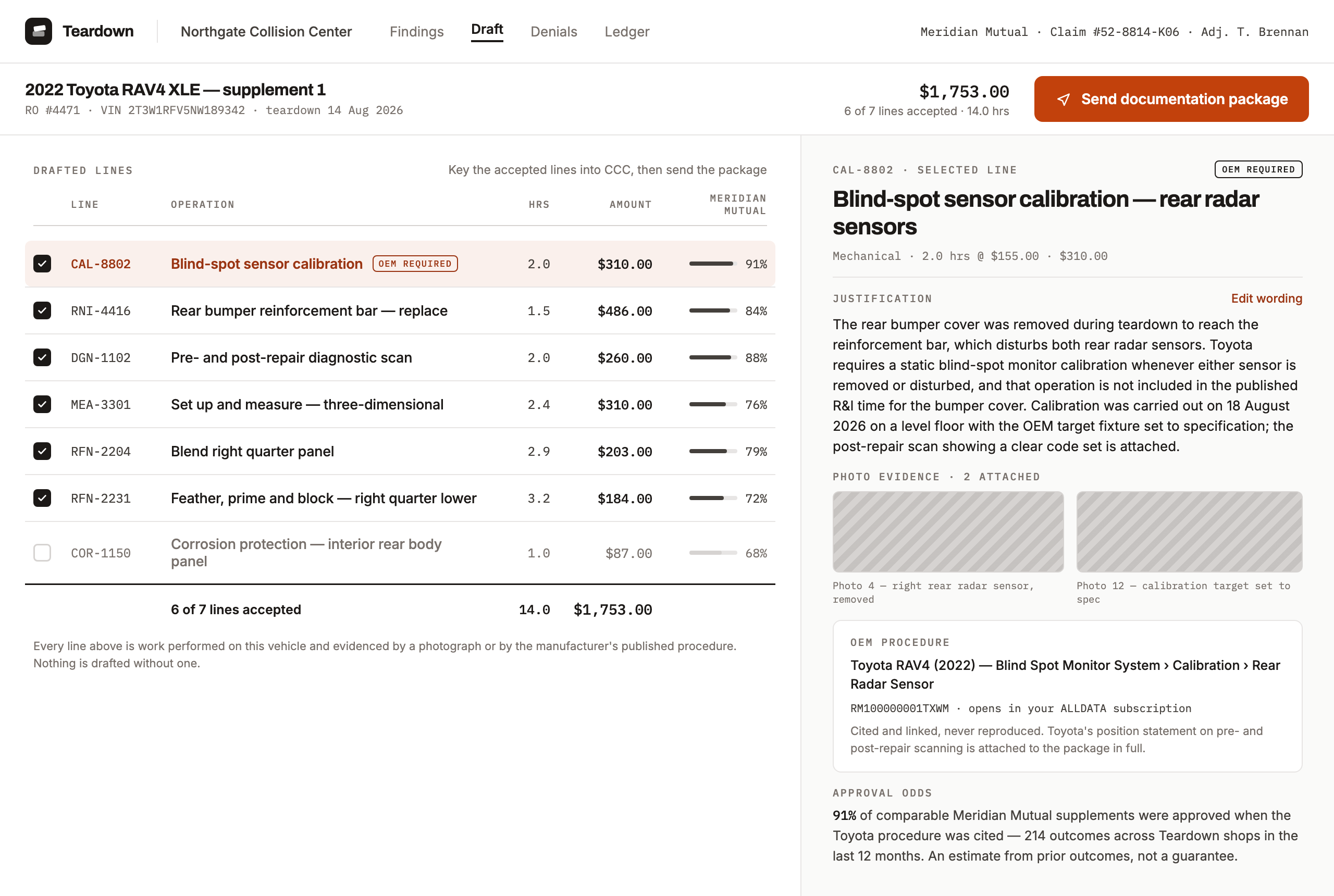
Design mockups, not a shipped product — but every figure, carrier and citation on them follows the rules the real thing will run on: fictional carriers, and no line without a photo or a procedure behind it.
The market
Roughly thirty thousand collision facilities operate in the US. We are not chasing all of them — the large consolidators build tooling in-house, so the target is the independents and small chains who have nobody to build it for them.
Drafting a supplement costs roughly $0.50–1.50 in model calls — long inputs, mostly cached — against $500–1,000 a month in subscription. The cost that matters is not compute, it is the sales call.
15–40 shops and $100–300K ARR. That is a judgement based on a solo founder selling direct, one shop at a time, and it assumes no channel deal appears to accelerate it.
Competition
Anyone who knows this industry can name five companies in the first minute, so there is no point pretending the space is empty. The opening is not absence. It is a conflict of interest that the largest players cannot resolve, and a set of shop-aligned vendors who are not built to exploit it.
| Who | What they are | Why we win |
|---|---|---|
| CCCNASDAQ: CCCS | The dominant estimating platform. Now markets AI-driven blueprinting. | Counter-positioned. CCC serves shops and insurers, and the insurers hold the leverage. A tool that helps shops extract more from adjusters attacks its own larger revenue line. |
| Mitchell, AudatexEnlyte · Solera | The other two estimating platforms. Qapter does AI photo estimating. | Same conflict, same constraint. Neither can be seen coaching shops to argue with the carriers who pay them. |
| OEC RepairLogic, ALLDATAMost dangerous | OEM procedure data, shop-aligned, already flag required operations. | No structural conflict — this is the real threat. But they are data-subscription businesses rather than AI-native ones, and they own no insurer-outcome loop. |
| Small AI entrantsEstimate-analysis tools | Early, and mostly marketing copy claiming OEM references. | Unproven, thin on negotiation knowledge, and holding no outcome data. A real race, just not a decided one. |
| Estimate review servicesHuman · offshore blueprinting | Shops already pay people to do exactly this work. | Not only a competitor — the proof of willingness to pay. The question is throughput and price, not whether the job is worth doing. |
| Tractable, Ravin, CCC AIWell funded | Serious collision AI, sold to insurers for cost containment. | They are pointed the other way. The shop side is left to small entrants and legacy data vendors, and that asymmetry is the opening. |
| Teardown$500–1,000/mo | Shop-aligned, AI-native, with an insurer-outcome loop that compounds. | Only useful to one side of the table — which is exactly why the incumbents can see it and still not build it. |
“Why won't CCC just build this?” They can, easily. They won't, because shipping it means selling shops a tool to extract money from the insurers who are their larger customers.
That is counter-positioning: visible to the incumbent, cheap to build, and still irrational for them to adopt. It buys years, not forever — and the outcome data accumulated in those years is what makes it hard to catch afterwards.
The Foundry
The plan is not to build more product. It is to put a working version in one paying shop and count the dollars it recovered that would not otherwise have arrived.
One number goes on the last slide: dollars recovered for the pilot shop, checked against their own supplements from the quarter before.
Not signups, not demos, not a waitlist. If the owner cannot point at money that would not otherwise have arrived, nothing has been demonstrated and we should say so.
If ten shops tell us the supplements they skip are worth under $100 each, the business isn't there. If our drafted lines get approved at a lower rate than what the shop's own estimator writes, the product isn't better than the person. If two carriers refuse the documentation package outright, the distribution assumption is broken. Any one of those inside eight weeks is a reason to stop, and finding it in week six is cheaper than finding it in year two.
Pre-pilot. Positioning, competitive analysis and the knowledge-base design are written down; the build and the shop interviews start now. Industry: Software, SaaS & AI-enabled Products, sold direct to independent collision repairers.
Deliberately not positioned as an insurance product. Teardown works for the shop, documents work already performed, and never touches the consumer's claim payout.